SMART & Lean Goals with the Lean Playbook
Go beyond simple goal tracking. Track Ideas through Hypotheses to Experiments, accumulate Evidence, and make data-driven Pivot or Persevere decisions with Innovation Accounting.
Stop Guessing. Start Validating.
90% of startups fail not because they couldn't execute, but because they executed on the wrong things. SMART goals help you execute faster. Lean goals help you learn what's worth executing. You need both.
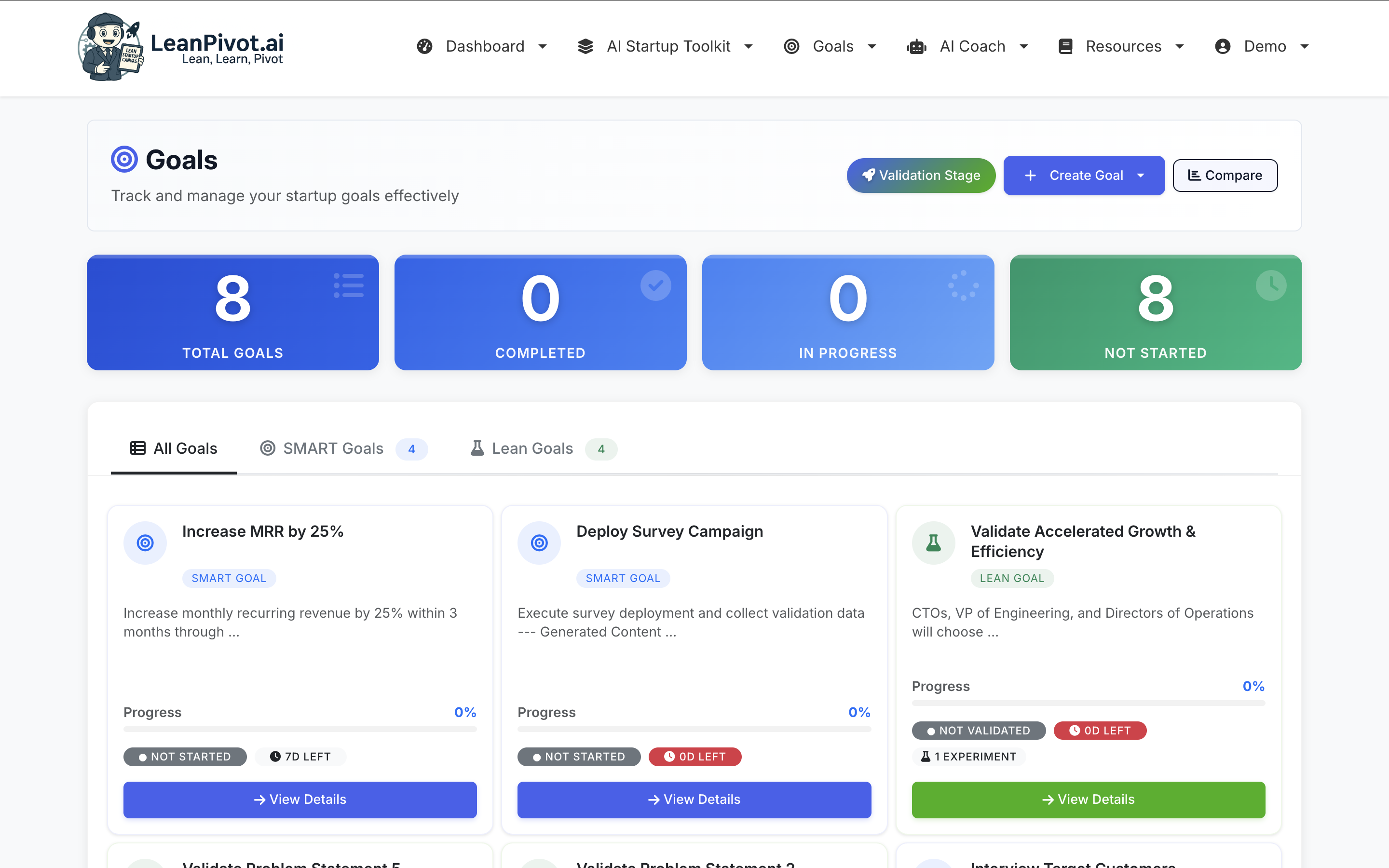
Your goals dashboard showing total goals, completion status, and a clear overview of both SMART goals for execution and Lean goals for validation, with progress tracking for each.
Introducing the Lean Playbook System
The Lean Playbook transforms simple goal tracking into a comprehensive validation lifecycle management system aligned with Innovation Accounting principles.
Ideas
Track business concepts through validation stages: Pre-Idea, Validating, Pre-PMF, Scaling
Structured ideationHypotheses
Test assumptions with risk assessment across Desirability, Viability, and Feasibility
Risk-scored testingExperiments
Run interviews, smoke tests, landing pages, and more with cost and sample tracking
15+ experiment typesDecisions
Make Pivot/Persevere/Kill decisions with evidence-based confidence
Evidence-drivenMost Founders Set the Wrong Goals
Execution Without Validation
"Build 50 features by Q2." But what if users only want 3 of them?
Learning Without Action
"Run 100 customer interviews." But when do you actually start building?
Vanity Metrics
"Get 10,000 Twitter followers." Cool, but did any of them become customers?
The Solution
Use SMART goals for execution AFTER you've used Lean goals to validate what's worth executing.
What are SMART Goals?
SMART goals are for execution--when you know what to build and need to track progress toward a specific outcome.
Specific
Clearly defined, leaving no room for ambiguity. "Increase revenue" is vague. "Acquire 100 paying customers at $99/mo" is specific.
No ambiguityMeasurable
Quantifiable criteria for tracking progress. You know exactly when you've hit the goal or how far away you are.
Track progressAchievable
Realistic and attainable with your current resources and constraints. Ambitious is good; impossible is demoralizing.
Realistic targetsRelevant
Aligned with your overall business objectives and current stage. Don't optimize for virality if you need revenue.
Stage-alignedTime-bound
Clear deadline or timeframe for completion. "Someday" is not a deadline. "By end of Q1 2026" creates urgency and focus.
Deadline-drivenExample SMART Goal: "Acquire 100 paying customers for our SaaS product at $99/month by the end of Q1 2026, achieving $9,900 MRR."
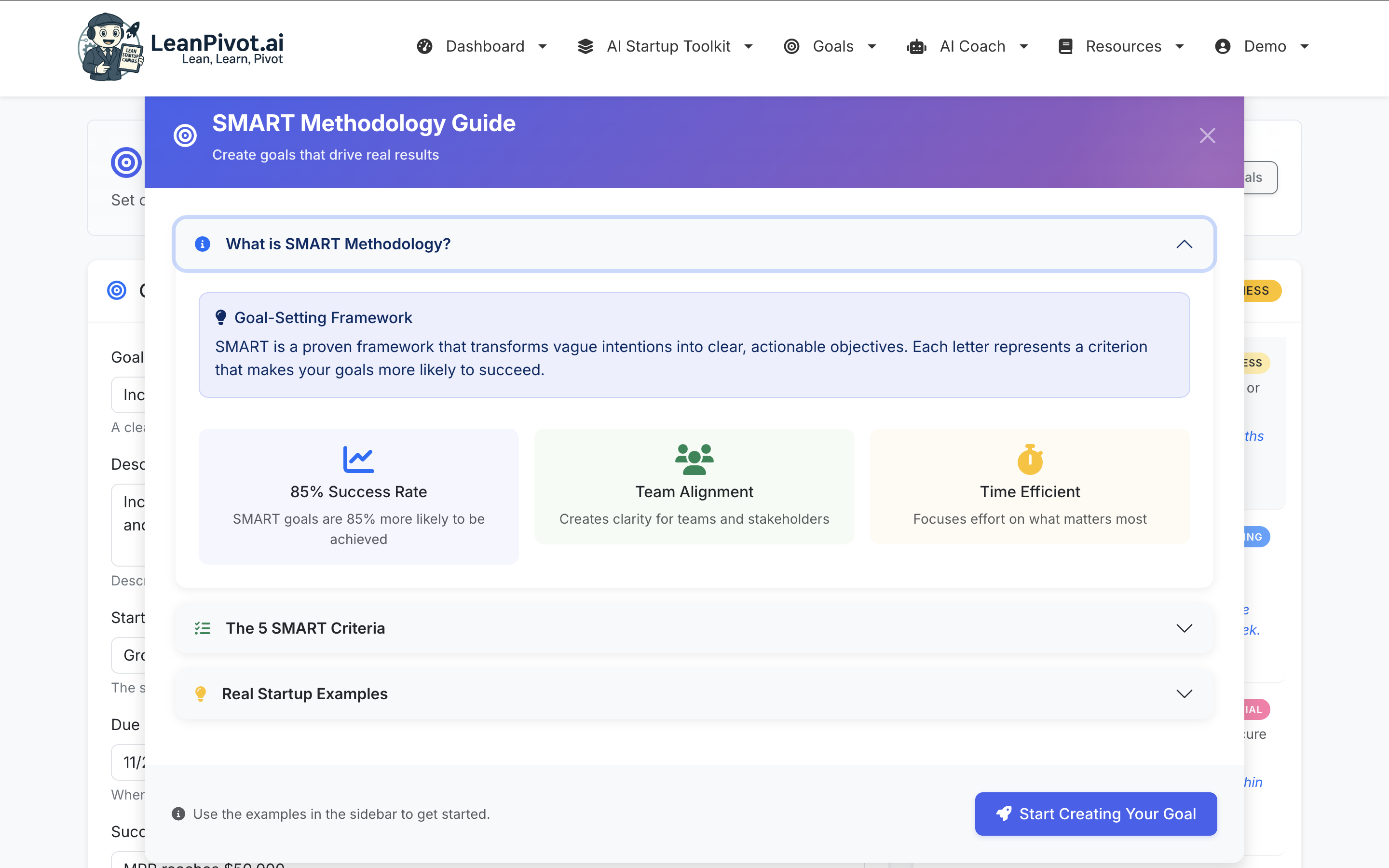
The SMART goal creation interface guiding you through setting specific, measurable objectives with AI-generated milestones and success criteria tailored to your startup stage.
What are Lean Goals (Hypotheses)?
Lean goals are for learning--when you have assumptions that need validating before you commit to execution. In the Lean Playbook, we call these Hypotheses.
Hypothesis-Driven Learning
Instead of "Build feature X," a Lean goal asks: "Will customers pay for feature X?" The goal isn't to build; it's to learn whether building is worth it.
The Lean Goal Framework
Every Lean goal follows this structure:
1. Hypothesis
"We believe [assumption] is true."
2. Test
"We will test this by [experiment]."
3. Metric
"We will know we're right when [measurable outcome]."
4. Decision
"If validated, we will [pivot/persevere]. If not, we will [alternative]."
Example Lean Goal: "Validate that small business owners will pay $99/month for automated bookkeeping by getting 20 pre-orders from a landing page in 2 weeks."
Risk Assessment Framework
Each hypothesis is assessed across three critical risk dimensions, helping you prioritize what to test first.
Desirability Risk
Do customers actually want this? Is the problem worth solving? Will they pay for a solution?
Customer demandViability Risk
Can you make money from this? Is the business model sustainable? Are unit economics favorable?
Business modelFeasibility Risk
Can you build this? Do you have the technical capability? Are resources available?
Technical capacityScore each from 1-5 to prioritize which hypotheses to test first. Focus on the highest-risk assumptions first!
Evidence Tracking
As you run experiments and collect feedback, your evidence level grows automatically.
Evidence Levels
Your evidence level auto-updates as you collect data from experiments and feedback.
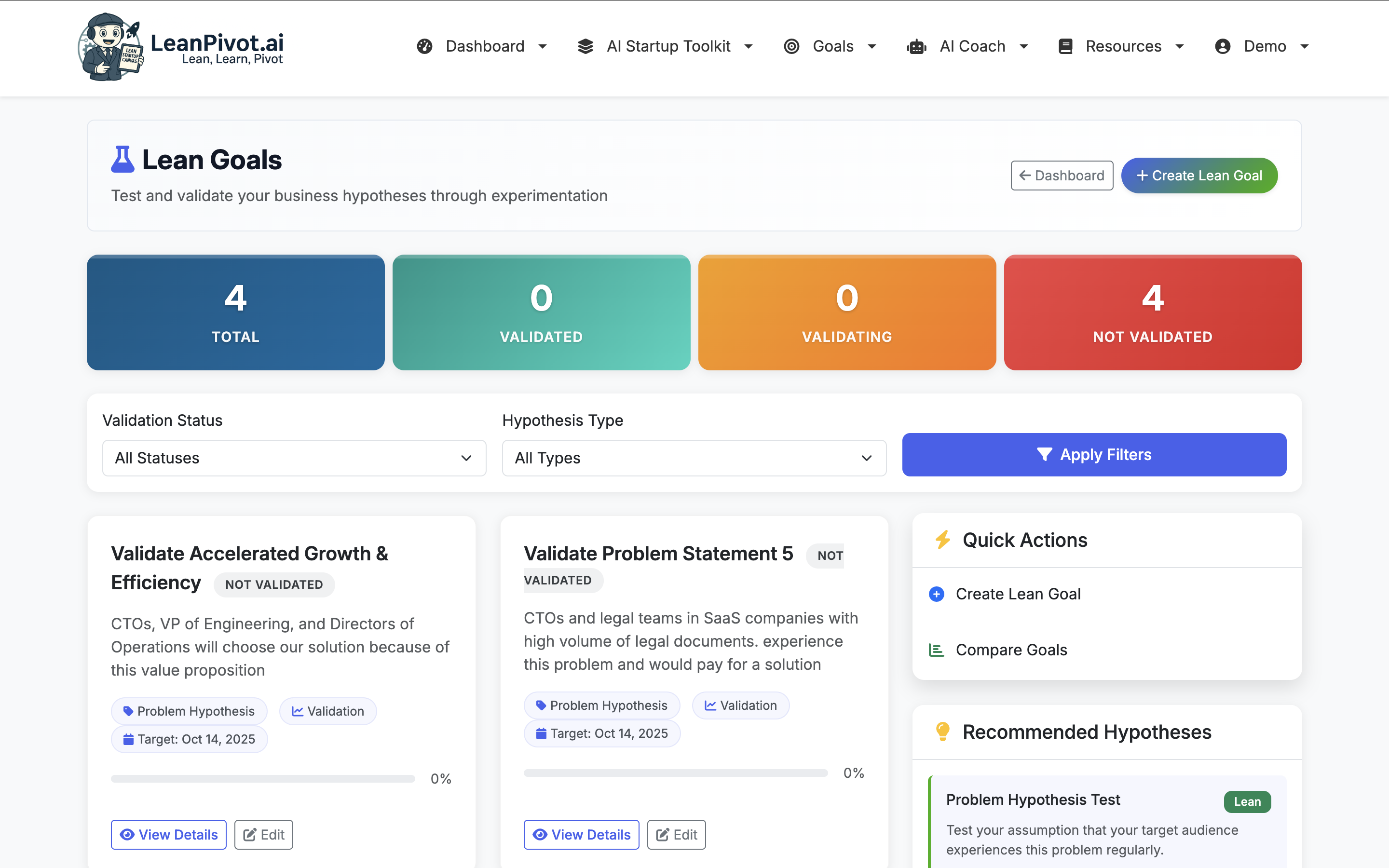
The Lean goals dashboard showing active hypotheses, experiment progress, validation status, and learning insights to guide your pivot-or-persevere decisions.
When to Use Each Type of Goal
Use SMART Goals When:
For execution on validated ideas.
- You've validated your core assumptions
- Scaling proven strategies
- Executing on known opportunities
- Meeting investor milestones
- Optimizing existing processes
- Building features users requested
Use Lean Goals When:
For learning before committing.
- Entering a new market
- Testing a new feature idea
- Validating pricing models
- Understanding customer pain points
- Testing marketing channels
- Any time you're making assumptions
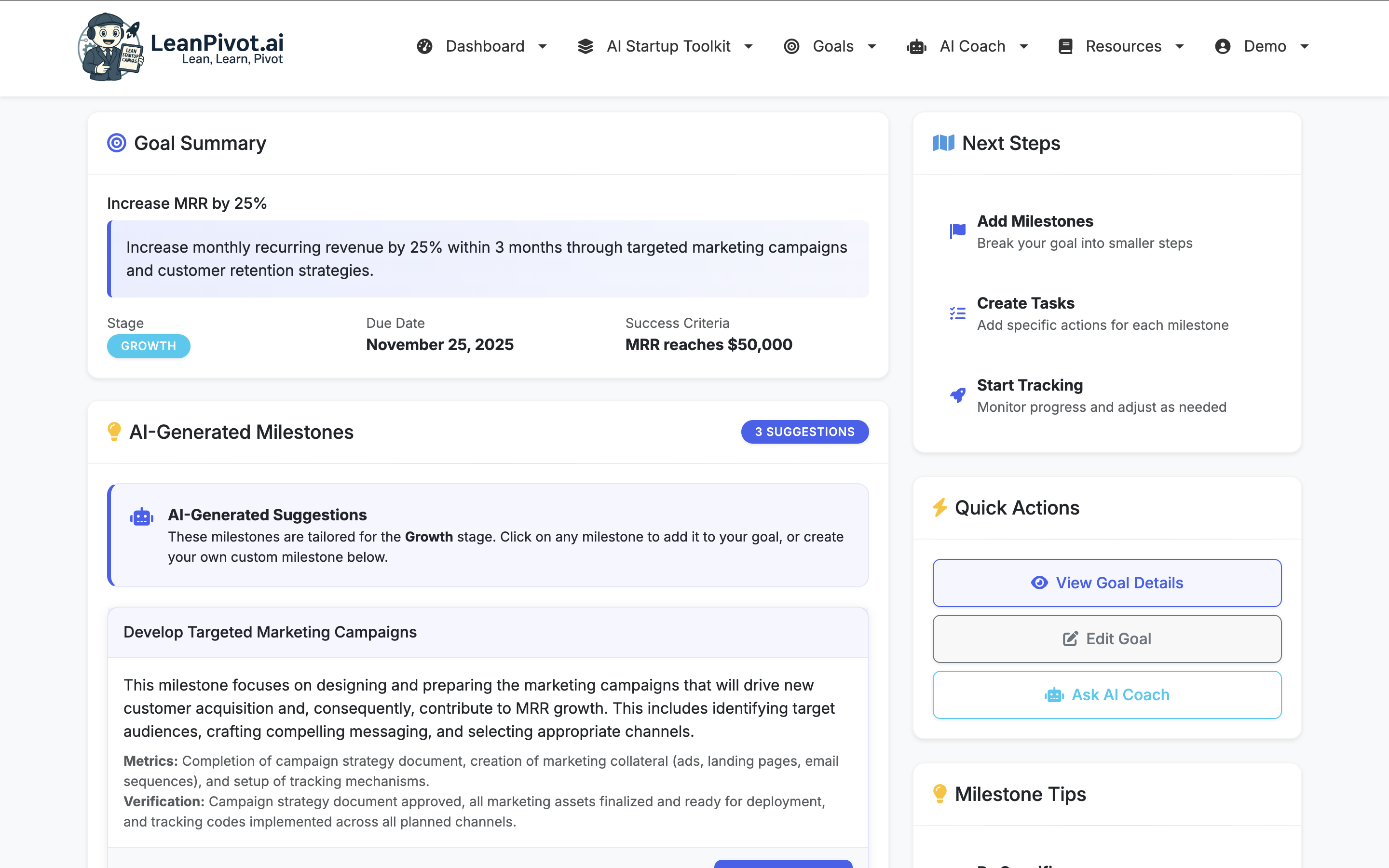
AI automatically generates milestones for your SMART goals
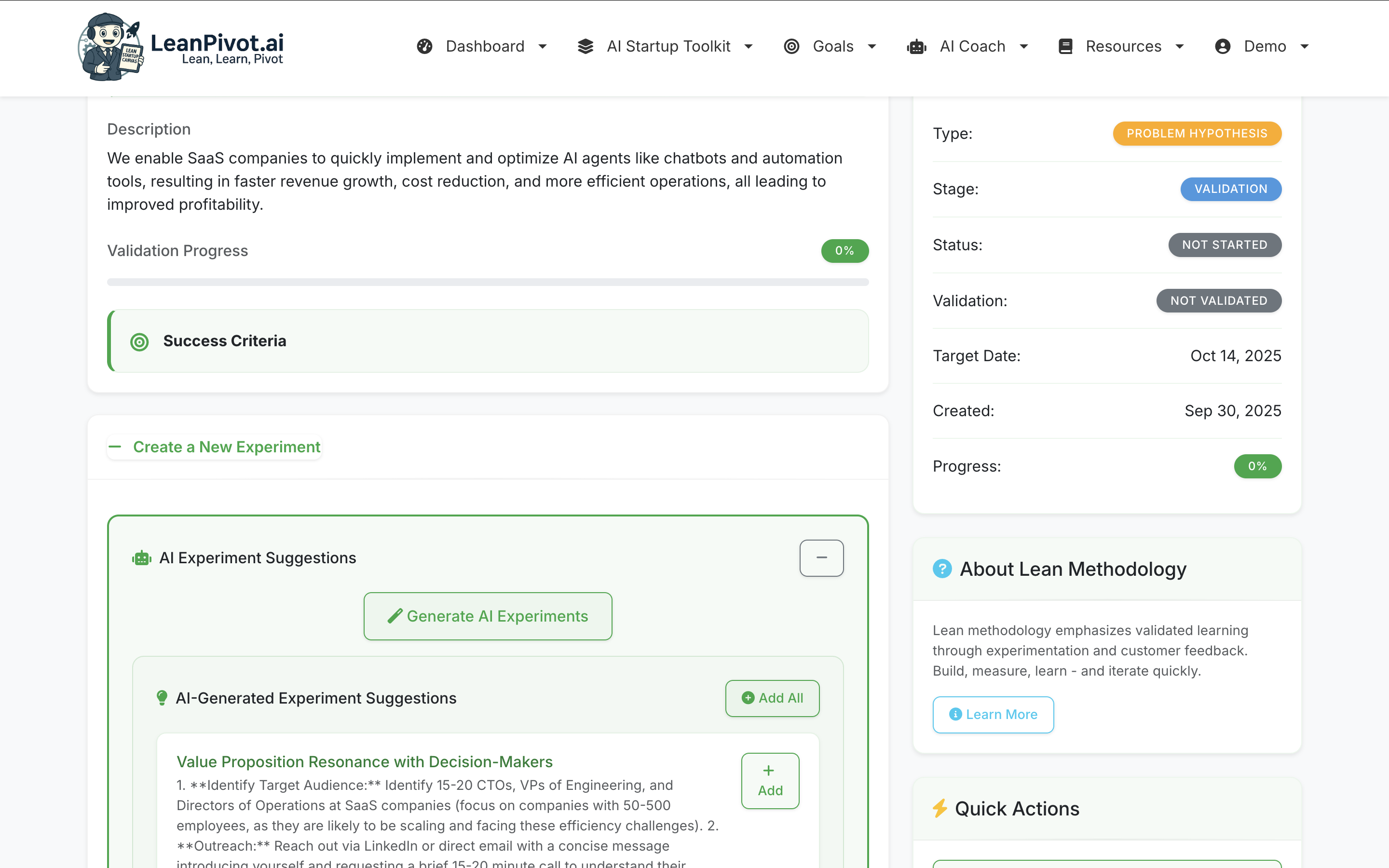
Design experiments to test your Lean hypotheses
How LeanPivot AI Supercharges Your Goals
1. AI-Generated Milestones & Tasks
When you create a goal, our AI breaks it down into actionable milestones and tasks based on your stage:
- Smart Breakdown: Big goals become manageable chunks
- Stage-Specific: Different tasks for ideation vs. growth stage
- Time Estimates: Realistic timelines for each milestone
- Success Criteria: Clear metrics for each milestone
2. Comprehensive Experiment Tracking
The Lean Playbook supports 15+ experiment types categorized by methodology:
Discovery
- Customer Interviews
- Surveys & Questionnaires
- Customer Observation
- Desk Research
Validation
- Smoke Tests (Fake Door)
- Landing Page Tests
- Concierge MVP
- Wizard of Oz
- Prototype Tests
- A/B Tests
Sales
- Pre-Sales / LOI
- Crowdfunding
- Pilot Programs
Each experiment tracks cost (money + time), sample size (target vs. actual), primary metrics, and signal strength.
3. Universal Feedback Capture
Capture every customer signal, not just interviews. The Lean Playbook logs all types of feedback.
Interviews
Emails
DMs & Chat
Surveys
Analytics
Purchases
Reviews
NPS Scores
Each feedback entry captures sentiment, verbatim quotes, key insights, and follow-up actions.
4. Decision Reviews
The most important part of validation isn't the experiments--it's the decisions you make based on evidence. The Decision Review system tracks your Pivot/Persevere/Kill decisions over time.
Decision Types
Choose from six strategic options:
- Continue Testing - Need more evidence
- Persevere - Hypothesis validated, move forward
- Pivot - Fundamental change needed
- Kill - Idea disproven, archive and learn
- Merge/Split - Consolidate or divide efforts
- Pause - Shelve for later consideration
Each Review Captures
Complete decision audit trail:
- Confidence level in the decision
- Evidence strength at time of decision
- Rationale and key learnings
- Number of experiments completed
- Feedback count snapshot
- Next steps and follow-up date
Build institutional memory: Track your pivot history, learn from past decisions, and create accountability for evidence-based entrepreneurship.
5. Progress Tracking & Analytics
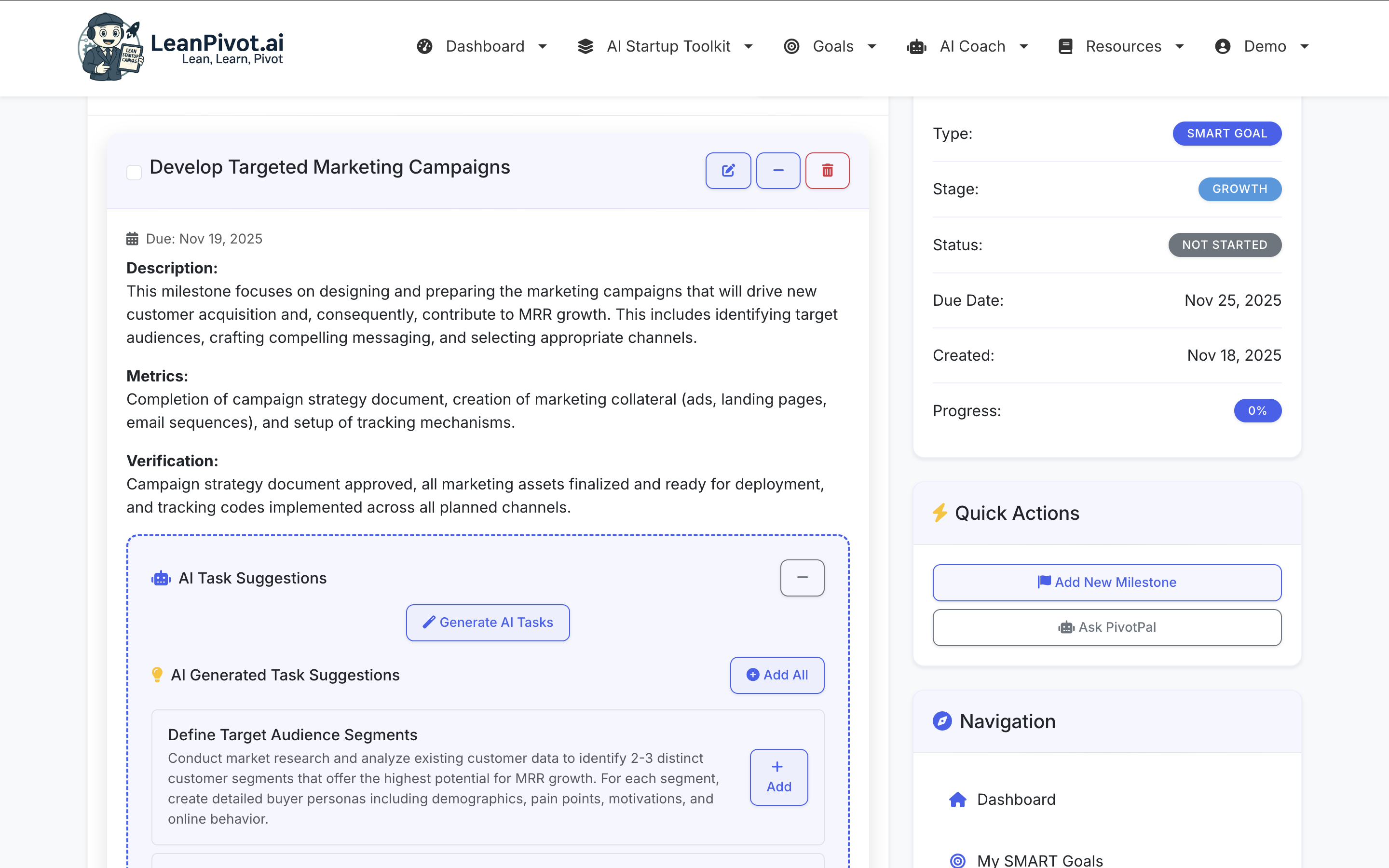
Each goal is automatically broken down into milestones and tasks with AI-generated suggestions, time estimates, and clear success criteria.
Visual dashboards show you:
Goals completed vs. in progress vs. overdue
Milestone completion rates
Experiment validation rates
Evidence accumulation over time
Risk assessment heatmaps
Decision review history
Bottlenecks and blockers
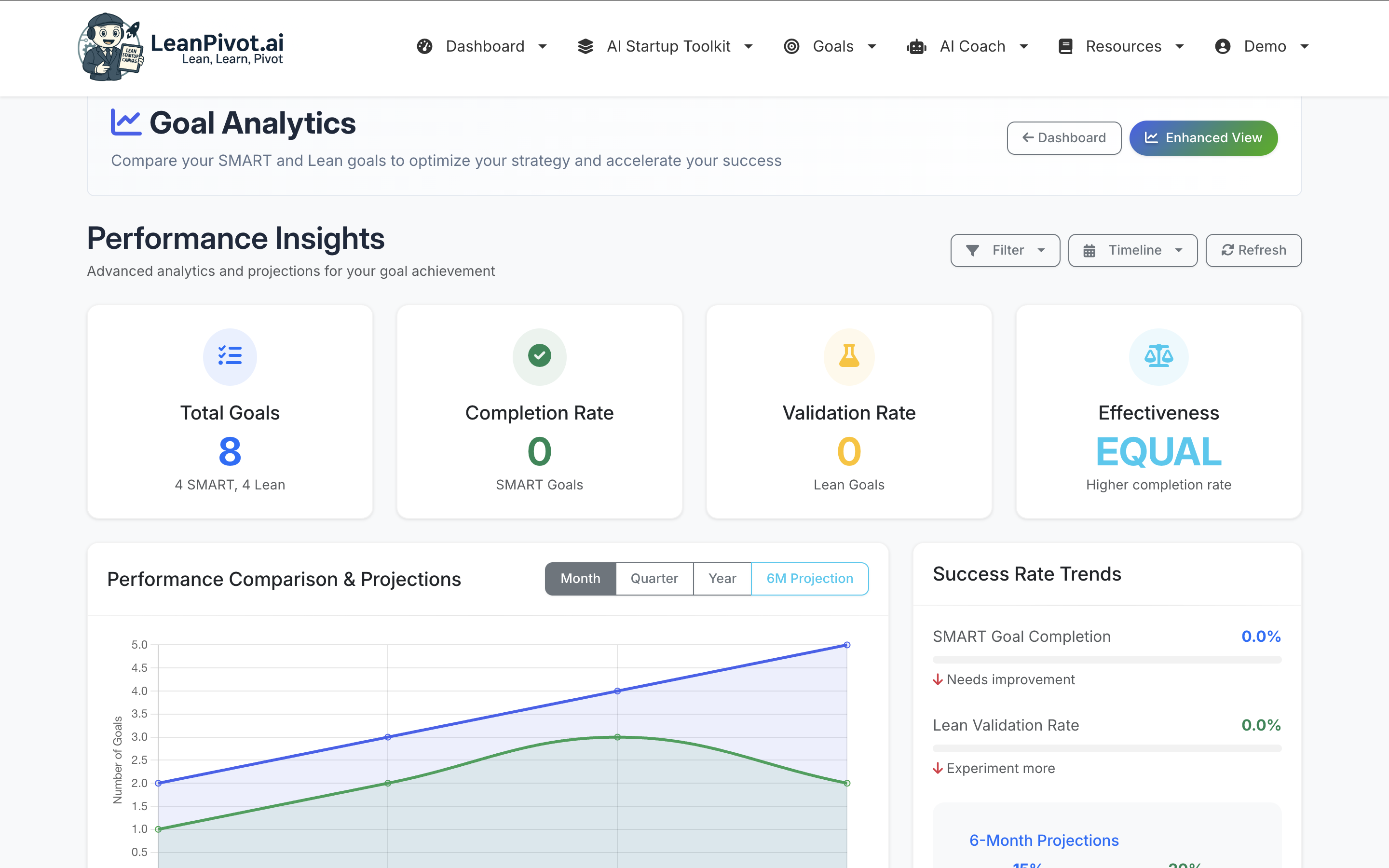
Comprehensive analytics showing goal completion rates, learning velocity, and insights to help you identify patterns and optimize your goal-setting strategy.
PivotBuddy Integration
Your AI co-founder remembers your goals and helps you achieve them:
- "I see you're trying to acquire 100 customers. Have you tried the growth tactics we discussed last month?"
- "Your Lean goal to validate pricing failed. Want to explore alternative pricing models?"
- "You completed 3 SMART goals this quarter but haven't set any new ones. Ready to plan for next quarter?"
Real Examples: Goals in Action
From Lean to SMART: A Success Story
Month 1 - Lean Goal: "Validate that fitness coaches will pay $49/mo for scheduling software by getting 15 beta signups."
Result: Got 23 signups. Hypothesis validated.
Month 2 - SMART Goal: "Convert 15 of those 23 beta users to paying customers at $49/mo by end of quarter."
Result: Converted 18. Now executing on validated demand.
Month 3 - New SMART Goal: "Acquire 50 more paying customers through content marketing, reaching $3,332 MRR."
When Lean Goals Save You from Failure
Initial Idea: Build a comprehensive project management tool (6-month development cycle).
Lean Goal Instead: "Validate that remote teams need better async communication by interviewing 30 team leads."
Learning: They don't want another PM tool. They want better meeting notes that turn into action items.
Outcome: Pivoted to a meeting assistant tool. Saved 6 months building the wrong product.
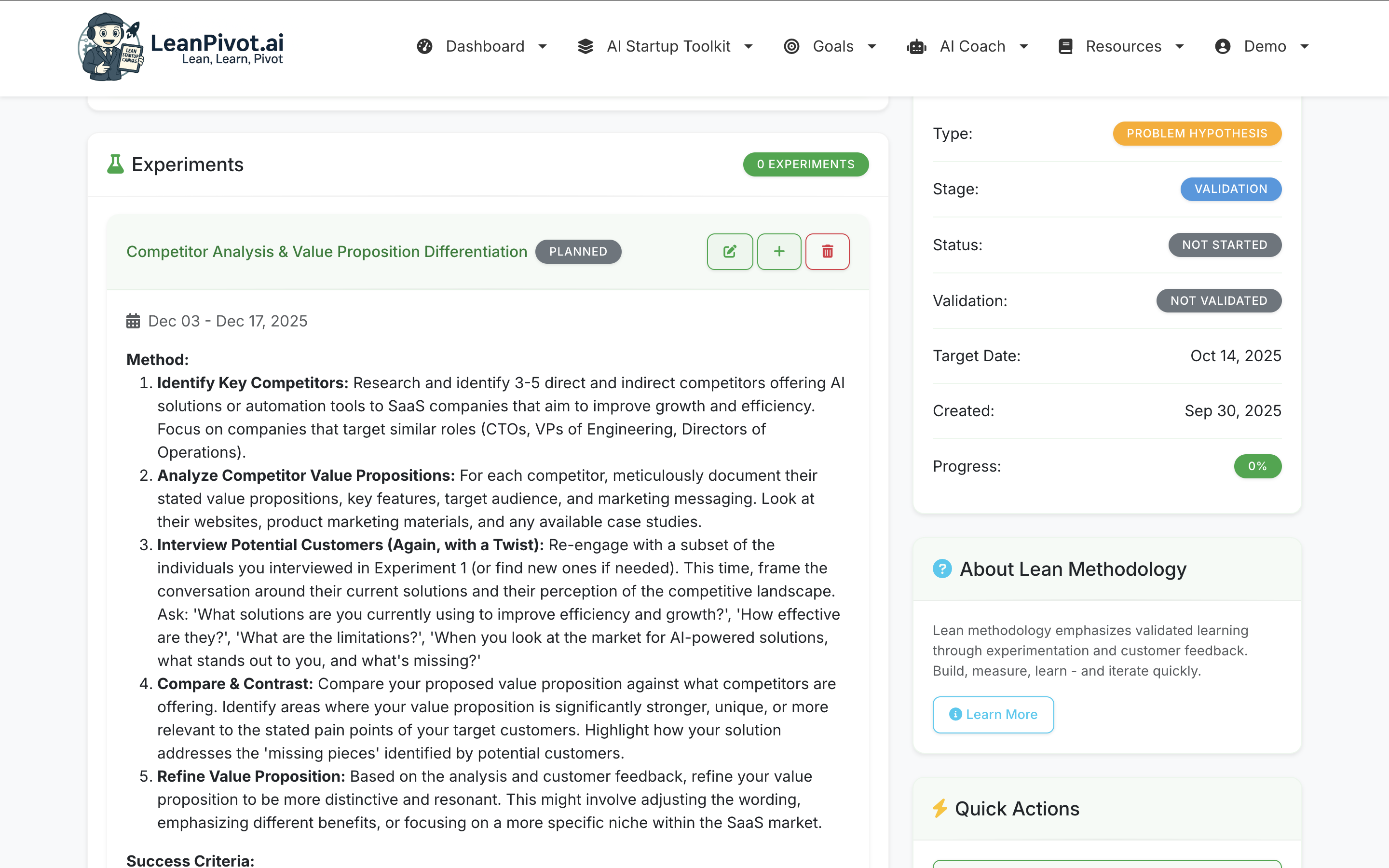
Track all your validation experiments, results, and learnings in one place, making it easy to see which hypotheses were validated and which led to pivots.
Best Practices for Goal Setting
Balance Both Types
Set 2-3 Lean goals for learning and 2-3 SMART goals for execution. Don't do all learning or all execution.
Balanced approachReview Weekly
Spend 30 minutes every week reviewing goal progress, updating tasks, and adjusting based on learnings.
Consistent reviewsDocument Learnings
For every Lean goal, document what you learned and how it influenced your next decisions. Build institutional knowledge.
Knowledge captureStart Small, Scale Up
Begin with 1-2 goals total. Once you build the habit of tracking and achieving, add more.
Progressive growthA Core Feature for All Plans
We believe that effective goal setting and validation is a fundamental skill for every entrepreneur. That's why the SMART & Lean Goals with the Lean Playbook is a Core Feature available to all users, on all plans.
Every Plan Includes
- Unlimited SMART and Lean goals
- AI-generated milestones and tasks
- Progress tracking dashboards
- Risk assessment framework
- Evidence level tracking
Plus More
- 15+ experiment types
- Universal feedback capture
- Decision reviews (Innovation Accounting)
- PivotBuddy integration for coaching
- Export for investor updates
Ready to Build an Evidence-Based Startup?
Stop guessing. Start validating. Use the Lean Playbook to track hypotheses, run experiments, accumulate evidence, and make confident Pivot or Persevere decisions.
Start Your Lean Playbook - Free