
You did it. You pushed through the "vibe coding" phase. You used your AI agents to build a functional app, you connected your database, and you hit that big blue button to make your project live for the whole world to see. You shared the link on social media, and suddenly, your phone starts buzzing. Your friends are liking the post. Your old coworkers are leaving comments that say, "Great job!" or "This looks amazing!"
It feels like a victory. In that moment of high-speed dopamine, you feel like a successful founder. But here is the hard truth that every solopreneur must face: you might be standing in a room full of fake gold.
In the Lean Startup world, the time right after launch is the most dangerous. This is because it is very easy to confuse "applause" with "success." Success in 2026 isn't measured by how many people saw your tweet; it’s measured by how many people used your tool to solve a real problem. If you want to build a real business that pays your bills and lasts for years, you have to stop counting likes and start counting truth. You need to move from the excitement of building into the discipline of measuring.
"The goal of a startup is to learn what customers actually want and will pay for, as quickly as possible. Measurement is the only way to separate fact from fiction."
1. The Trap of Vanity Metrics: The "Sugar High" of Startups
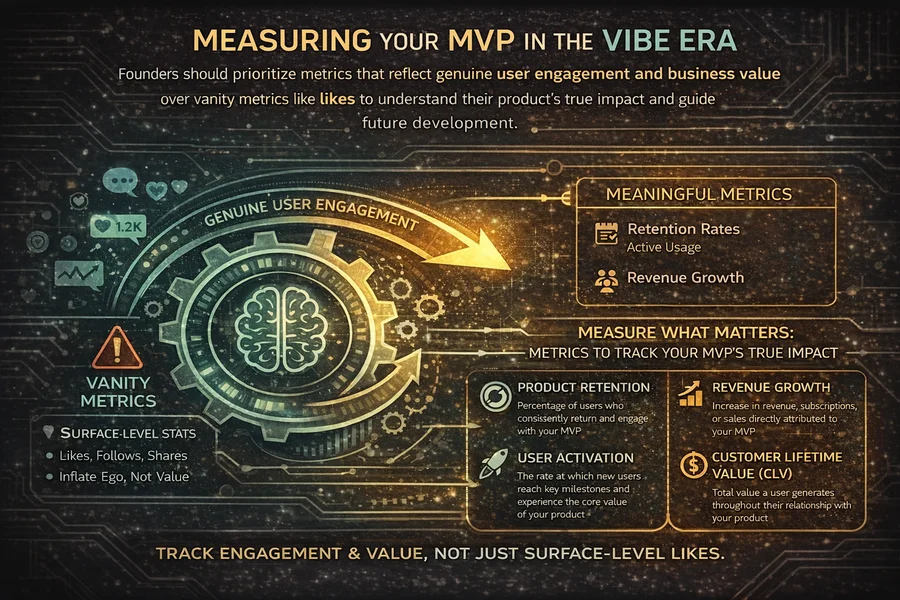
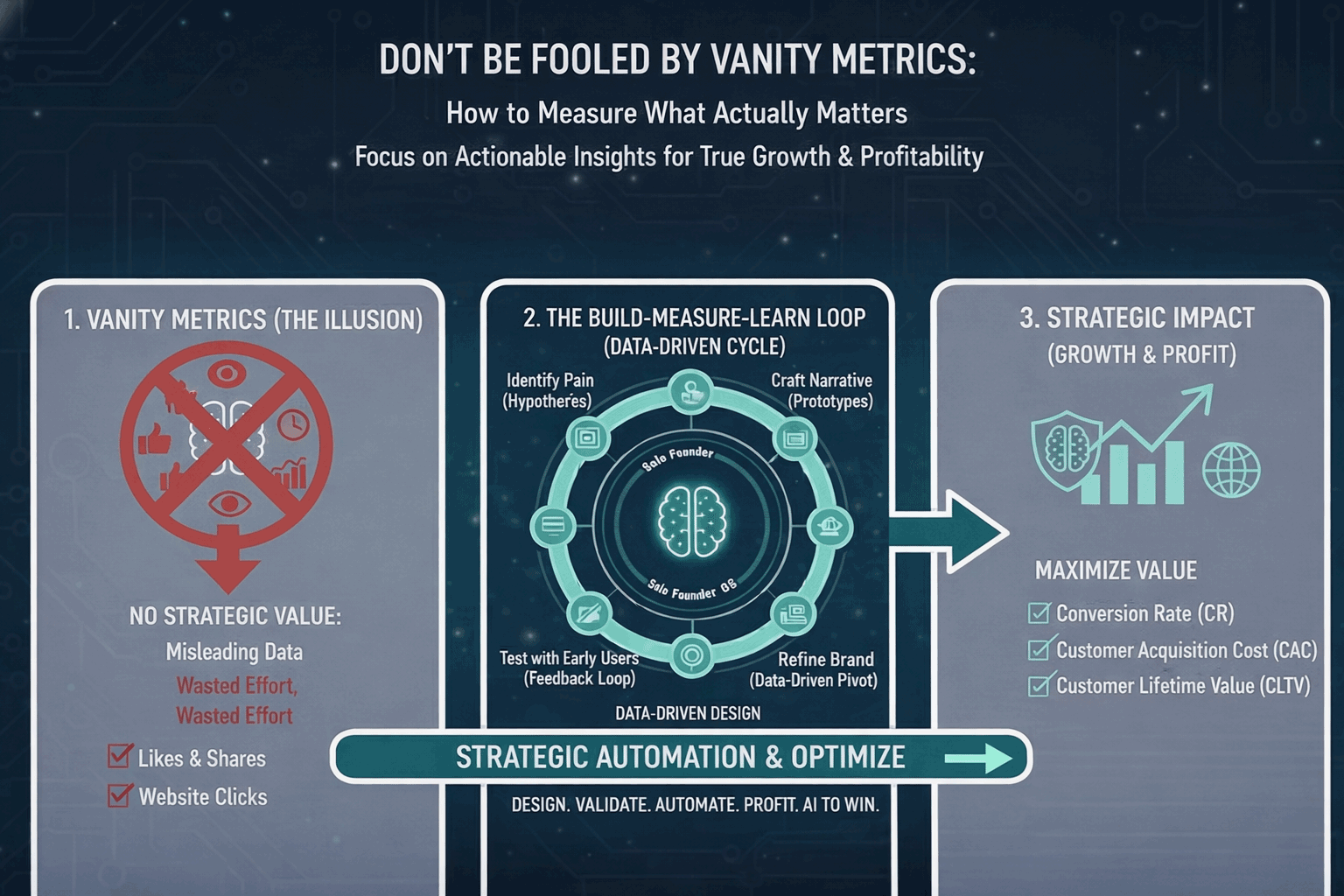
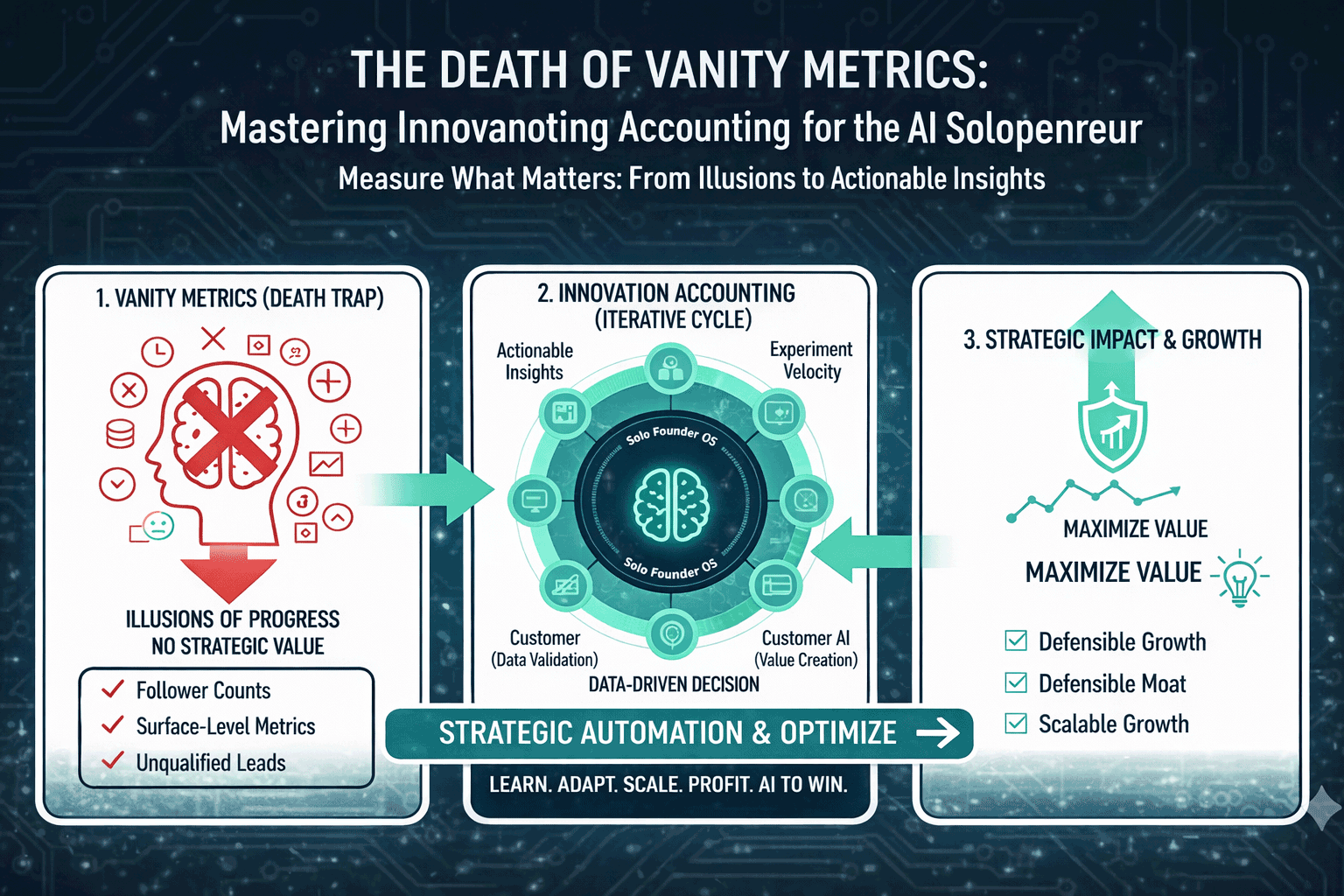
The biggest mistake new solopreneurs and early-stage founders make is falling in love with "vanity metrics." These are numbers that make you feel good—and look good to others—but don't actually tell you if your business is healthy or sustainable.
Think of vanity metrics like empty calories. If you eat a huge bag of cotton candy, you’ll feel a "sugar high" for a few minutes, but your body isn't getting any real nutrition. Page views, social media follows, and "likes" are the cotton candy of the startup world. They look bright and fluffy, but they won't keep you alive when the initial hype dies down.
Why Vanity Metrics are Dangerous:
- False Security: Seeing a thousand visitors on your landing page feels like growth. But if 990 of them left within five seconds (a high "bounce rate"), those thousand visits were actually a failure of your value proposition.
- Wasted Effort: If you focus on views, you will spend all your time on marketing and "hype-building" rather than fixing a product that isn't working.
- The Ghost Town Effect: You can have ten thousand sign-ups, but if no one is actually active, you are building features for a ghost town.
⚠️ Important: If a metric doesn't help you make a decision or change your behavior, it's a vanity metric. Real metrics lead to action; vanity metrics lead to ego.
2. The Mom Test: Searching for Brutal Truth
To get real data, you have to find people who are willing to tell you that your "baby" is ugly. This brings us to a famous concept called "The Mom Test," based on the work of Rob Fitzpatrick. It’s a simple rule: everyone will lie to you if they think it will protect your feelings.
When you show your new app to your mom, your best friend, or your partner, they aren't looking at the product. They are looking at you. They know how hard you worked. They know you stayed up late "vibe coding" until your eyes were red. Because they love you, they will tell you the idea is "great" even if they would never actually use it. They are protecting your feelings, but in doing so, they are hurting your business.
How to Find "Honest Wows":
To measure the truth, you must seek out strangers. You need feedback from people who don't care about your feelings. These are the people who have the problem you are trying to solve. If a stranger uses your app and then tells you, "This is confusing," or "I don't see why I would pay for this," that is the most valuable information you can get. It is brutal, but it is honest.
Your goal in the "Measure" phase is to find out if you have earned an "Honest Wow." An honest wow happens when a user solves a problem so effectively with your tool that they can't imagine going back to their old way of doing things. You don't get that from your mom; you get that from the market.
3. Measuring the "Magic Moment" Path
In the building phase, we identified the "Magic Moment"—the specific second where the user feels the core value of your product. In the measurement phase, your job is to track the conversion funnel that leads to that moment.
If you built a tool that uses AI to summarize long meetings, the magic moment isn't the user signing up. It isn't even the user uploading a file. The magic moment is when the user reads a summary that is actually accurate and saves them an hour of work. You need to set up "telemetry" to tell you exactly where people are getting stuck on the way to that summary.
Looking at these numbers, you can see that the "leak" in your bucket is at the upload stage. You have a hundred people sign up but only five people actually finish an upload. Your data is telling you that something is broken. Maybe the upload button is hidden, or maybe the instructions are confusing. By measuring the path, you know exactly what to fix.
4. Footprints in the Sand: Event-Based Tracking
How do you actually see what users are doing? In 2026, we have incredible tools that act like "digital footprints." For solopreneurs, tools like PostHog or Umami are your beach. They allow you to see "events"—the specific actions a user takes.
The beauty of the modern AI tech stack is that you don't need to be a data scientist to set this up. You can simply prompt your AI-first editor: "Help me add an event tracker to my 'Generate Summary' button so I can see how many people actually use the core feature." The AI will give you the telemetry code, and suddenly, you have a dashboard that shows you the truth. You aren't guessing anymore; you are observing.
✅ Pro Tip: Focus on "Active Use" events rather than "Click" events. Seeing that someone clicked a button is good, but seeing that someone completed a workflow is the real signal.
5. Retention: The King of All Metrics
If you only remember one thing about measurement, let it be this: Retention is everything. Retention is a fancy word that just means "people coming back." If you have a hundred people use your app on Monday, and fifty of them come back on Tuesday, your retention is fifty percent.
The Leaky Bucket Analogy
Imagine you have a bucket that you are trying to fill with water. If the bucket has a huge hole in the bottom, it doesn't matter how fast you pour water in; the bucket will always be empty. In the startup world, new users are the water, and your app is the bucket. If your retention is low, you have a "leaky bucket."
Founders often try to fix a leaky bucket by spending more money on ads to get more users. This is a catastrophic waste of money. If people don't want to stay, getting more people to visit just means more people will leave. High retention is the ultimate proof of a good product. It shows that your "Magic Moment" is so good that people want to experience it again and again.
6. Revenue: The Final Hurdle of Validation
Someone can tell you they like your idea. They can sign up for your free trial. They can follow you on X. But none of those things require a "sacrifice." The most honest metric in the world is a credit card transaction.
When someone pulls out their wallet and pays you ten or twenty dollars, they are saying, "The value you are giving me is worth more than this money." In the 2026 stack, we use "Merchant of Record" tools like Lemon Squeezy or Paddle to handle the scary parts of money, like global taxes and legal rules. This allows you to test your pricing almost instantly.
💡 Key Insight: Don't wait until your product is "finished" to ask for money. Try to sell a "Pro" version of your MVP on Day 1. One person paying you $10 is worth more than a thousand people saying, "This looks cool" for free.
7. The "March Members" Mentality
To understand how to read your data, think about gym memberships. Every year in January, thousands of people sign up for the gym. This is a "vanity metric" for the gym owner. It looks like the business is booming!
But the "truth metric" is how many of those people are still showing up in March. If the gym is empty by March, the business is in trouble, even if they had a record-breaking January. As a founder, you are looking for your "March members." Who are the users who found your tool two weeks ago and are still using it today? Find those people and talk to them. Ask them why they stayed. Their answers will tell you what the most valuable part of your product really is.
8. Psychological Discipline: Managing the Ego
Measuring is hard because it often hurts our ego. We want the data to show that we are geniuses. When the data shows that users are ignoring our favorite feature, it's tempting to make excuses. We say, "Oh, they just don't understand it yet," or "I just need to change the color of the button."
Resist this feeling. The data is not an insult; it is a map. If the map says there is a mountain in your way, you don't get mad at the map. You change your route. Being a successful solopreneur requires you to be a scientist. A scientist doesn't get "mad" if an experiment fails. They say, "Interesting. That didn't work. Now I know what to try next."
Conclusion: From Data to Learning
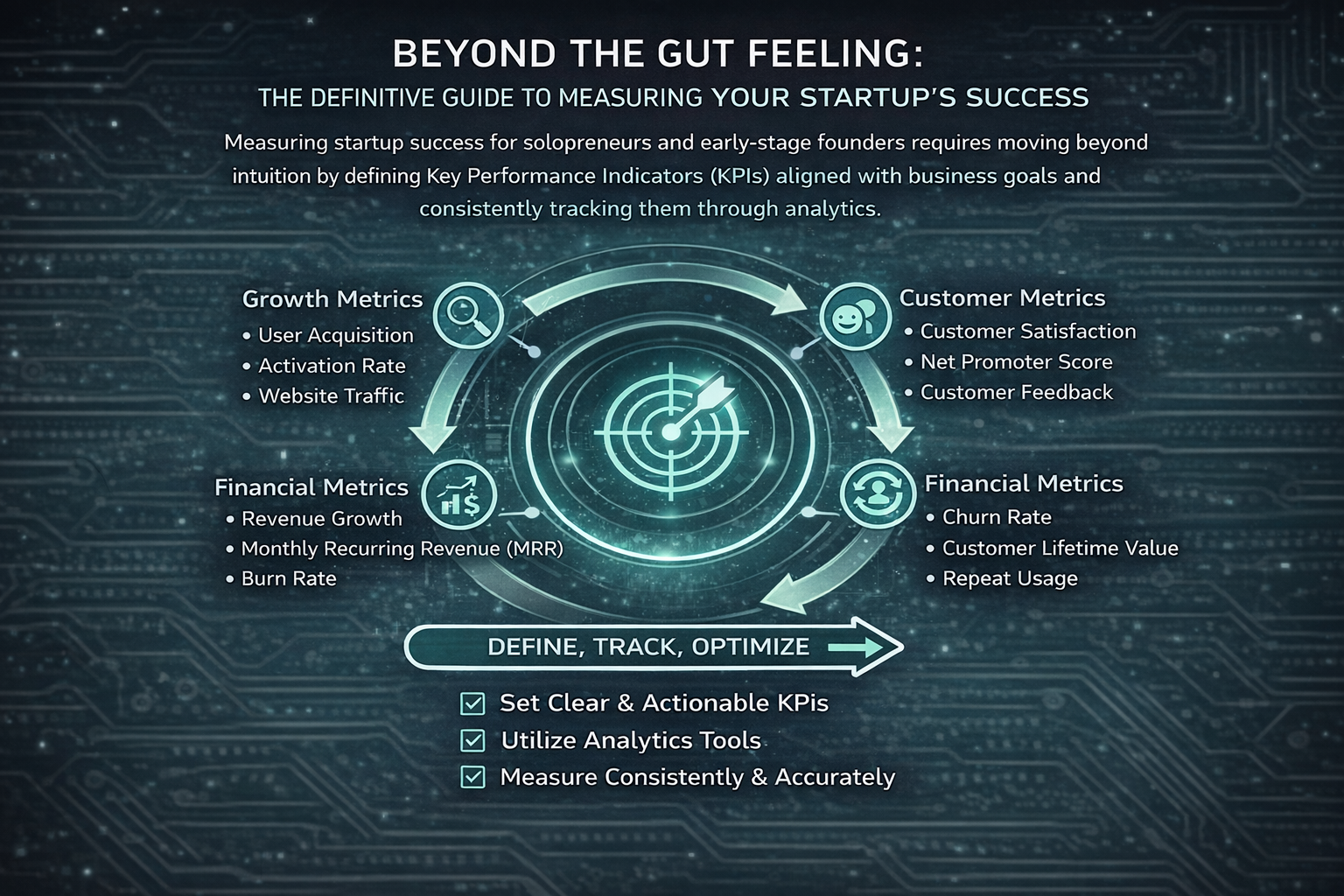
By the time you finish the "Measure" phase, you should have a clear, unvarnished picture of your business. You should know how many people are visiting, how many are reaching the "Magic Moment," how many are coming back, and how many are willing to pay. You are no longer "vibing" in the dark. You have a flashlight.
With this information, you are ready for the final and most important part of the loop: Learning. The numbers have told you the story of what is happening. Now, you have to decide why it is happening and what to do next. Are you on the right track, or is it time to pivot? Because you kept your costs low and built your MVP fast, you have the freedom to make that choice without fear.
Give up the likes. Chase the truth. That is how you build a business that actually lives.

No comments yet
Be the first to share your thoughts on this article!